Author: Will Hay

  • Prepare. Perform. Enjoy.

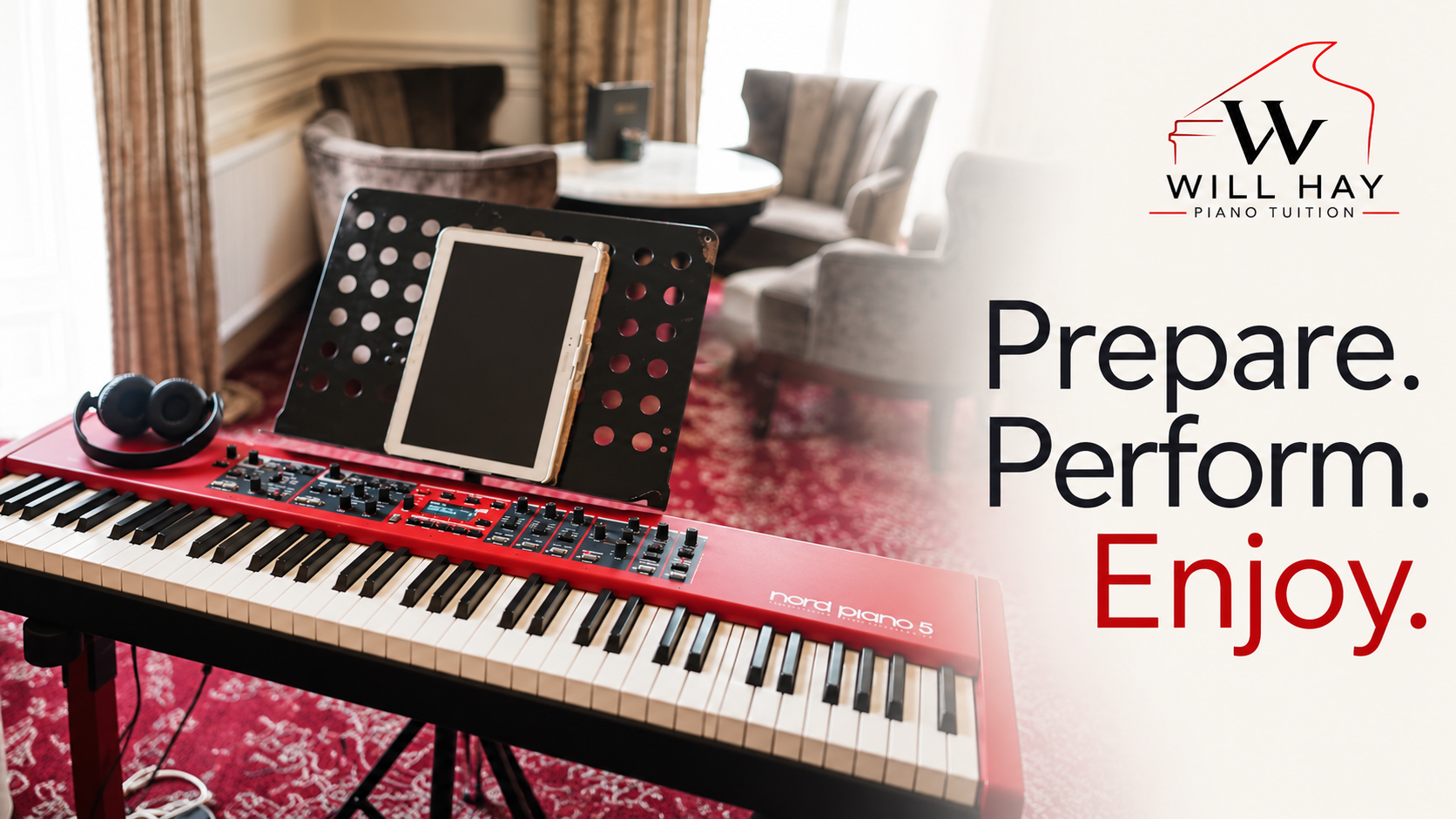
    Prepare. Perform. Enjoy.

    This weekend I swapped teaching piano for playing it, providing the music for a wedding reception at Rookery Hall.

    For the guests, the performance began when I sat down at the piano and started playing. For me, it had begun rather earlier.

    A little glimpse behind the scenes, from preparing at home to packing everything away again afterwards.

    Prepare

    Earlier in the week, I spent some time at my Yamaha U3 revisiting pieces for the reception. Much of the music was familiar, but familiar doesn’t necessarily mean ready to perform. There are always details to revisit and passages that benefit from a little attention.

    The U3 had also just been tuned and was sounding particularly lovely. Preparation isn’t only about practising: looking after the instrument, organising music and making sure everything is ready are all part of the process.

    On Saturday that continued with setting up, soundchecking and getting everything ready before the guests arrived.

    Then it was time to stop preparing.

    Perform

    Once the reception began, there wasn’t much point wondering whether another half-hour of practice might have helped.

    It was simply time to play.

    And there’s a rather nice parallel with what’s happening in lessons at the moment.

    Over the last week I’ve been talking to lots of pupils about what they might play at our Autumn Showcase on Sunday 15 November. We’ve been choosing pieces and starting to think about what needs to happen over the next few weeks to make them ready to share.

    I’ve also emailed parents with the registration details, so if your child would like to perform and you haven’t registered them yet, there’s still time to do so.

    The setting may be rather different from a wedding reception, but the process is much the same:

    Choose something. Prepare it. Then share it.

    Enjoy

    And perhaps this is the most important bit.

    We don’t practise simply to become better at practising.

    The repetitions, difficult bars, slow play-throughs and occasional moments when our fingers seem determined to develop opinions of their own are there to get us to the point where we can enjoy making music.

    I certainly enjoyed playing on Saturday, and it was lovely to have several guests come over at the end of the reception to tell me how much they’d enjoyed the music too.

    That’s ultimately what all the preparation is for.

    The same applies to the Autumn Showcase. It isn’t an exam and it isn’t about producing a perfect performance. It’s an opportunity to prepare something, experience sharing it with other people and, hopefully, enjoy doing so.

    There’ll even be coffee and bring-and-share cake, which should help with the final part.

    Prepare. Perform. Enjoy.

    There’s a connection here with the Play. Progress. Enjoy. idea that runs through my teaching.

    Playing regularly helps us progress, and that progress opens up more opportunities to enjoy making music.

    When we’re working towards a particular musical moment, perhaps we can think of it slightly differently:

    Prepare. Perform. Enjoy.

    Preparation isn’t about achieving perfection.

    It’s about doing enough beforehand that, when the moment arrives, we can stop worrying about getting ready and enjoy being part of it.

    And for quite a few of us at the moment, that next moment is 15 November.

  • Autumn Piano Showcase 2026

    Autumn Piano Showcase 2026

    I’m delighted to be planning our Autumn Piano Concert Showcase, taking place at The Firs School, Chester, on Sunday 15 November 2026 at 2.00pm.

    This will be a deliberately informal, open-mic-style concert rather than a formal recital. The idea is to give everyone the chance to play in a relaxed and supportive setting, whether you’re performing in public for the first time or you’ve done plenty of concerts before. 

    I’d love as many students as possible to take part. Over the next few weeks, have a think about pieces you genuinely enjoy playing and might like to share. They don’t need to be your hardest pieces or something you’re preparing for an exam. A piece you feel comfortable with and enjoy performing is often the best choice.

    Register to perform in the concert

    After the music, we’ll stay for coffee, drinks and cakes, so it can be a social occasion as well as a concert. If families would like to bring a cake or something sweet to share, that would be very welcome.

    The important bits

    • Sunday 15 November 2026
    • 2.00pm
    • The Firs School, Chester
    • Informal, open-mic-style piano performances
    • Students of all ages and levels welcome
    • Bring cakes to share afterwards if you can!

    There’s no pressure to perform, but I hope lots of you will decide to have a go. Playing for other people is a brilliant part of learning an instrument, and this is intended to be a friendly opportunity to share the music you love with other students, families and friends.

  • Playing together

    Playing together

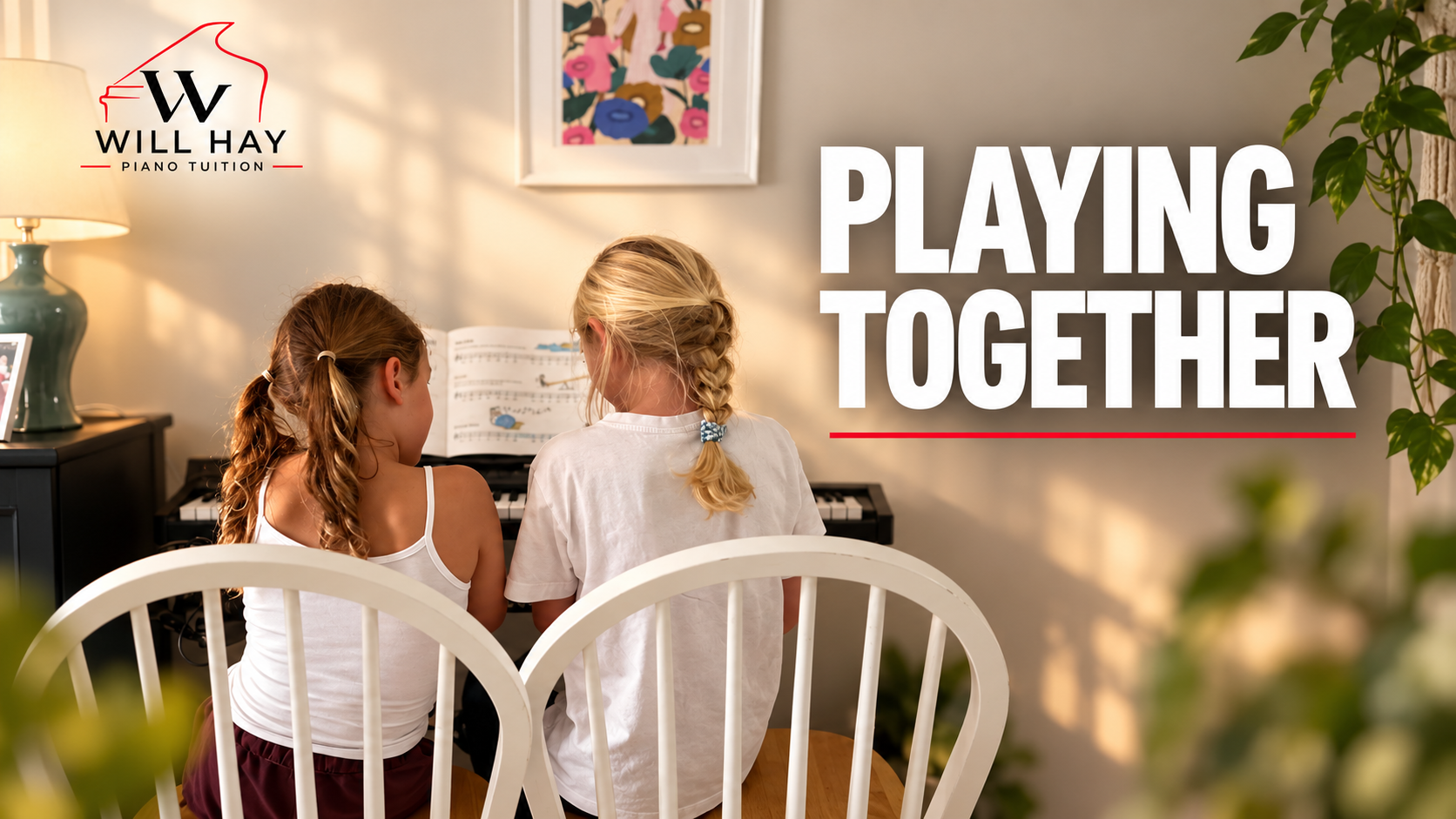
    Phoebe and Willow are preparing a duet and have shown great enthusiasm at having the chance to play together, so I thought this would be a good week to talk about duets.

    Piano practice is often something we do on our own. A duet gives us someone else to listen to, and another reason to get a piece ready!

    There’s quite a lot involved. Both players need to keep a steady pulse, listen to the other part and agree how the music should sound. Getting your own notes right is only part of it. You also need to know how they fit with what the other person is playing.

    You also need patience when something doesn’t go according to plan. Your duet partner might hesitate or play a wrong note. In that moment, you have a decision to make. Do you continue, or do you wait for the other person?

    With experience, you learn how to keep the music flowing and help each other along. You come to a non-verbal agreement as the music progresses, listening and adjusting, and hopefully arrive at the end of the piece together!

    We’ve been exploring listening and responding through the Autumn Leaves project too. The short call-and-response sections give pupils a chance to play an idea, hear an answer and leave space for someone else.

    Playing together can also be a lovely way to revisit a favourite piece. Something familiar can feel quite different with another part alongside it, whether that’s a teacher accompaniment or a duet with another pupil.

    At home this week, perhaps ask which piece your child would most like to share with someone. It could be something they’re learning now, or an old favourite they still enjoy playing.

    I’d be interested to hear their choices. We might find a few ideas for future duets!

  • Practice: finding a routine

    Practice: finding a routine

    Where, when… and what happens next?

    This week I’ve been asking my students three simple questions about practice:

    Where do you practise?
    When do you practise?
    Do you receive a reward?

    The answers have been fascinating. Most students can tell me where they practise. Far fewer have a clear answer to when.

    I’ve heard when Mum reminds me, when I get bored, sometimes after school and at the weekend. One student, though, said before bed, nearly every day.

    And I think that’s the missing ingredient: routine.

    Making practice part of the day

    It’s not necessarily about finding more time. It’s about making piano part of a routine that already exists:

    After breakfast. After school. After tea. Before bed.

    For younger students, parents will inevitably help establish that routine. But instead of Mum or Dad having to ask “Have you practised?” every day, the routine itself can gradually become the reminder.

    Practice isn’t just playing pieces

    Practice doesn’t have to mean sitting down and playing through this week’s pieces from beginning to end.

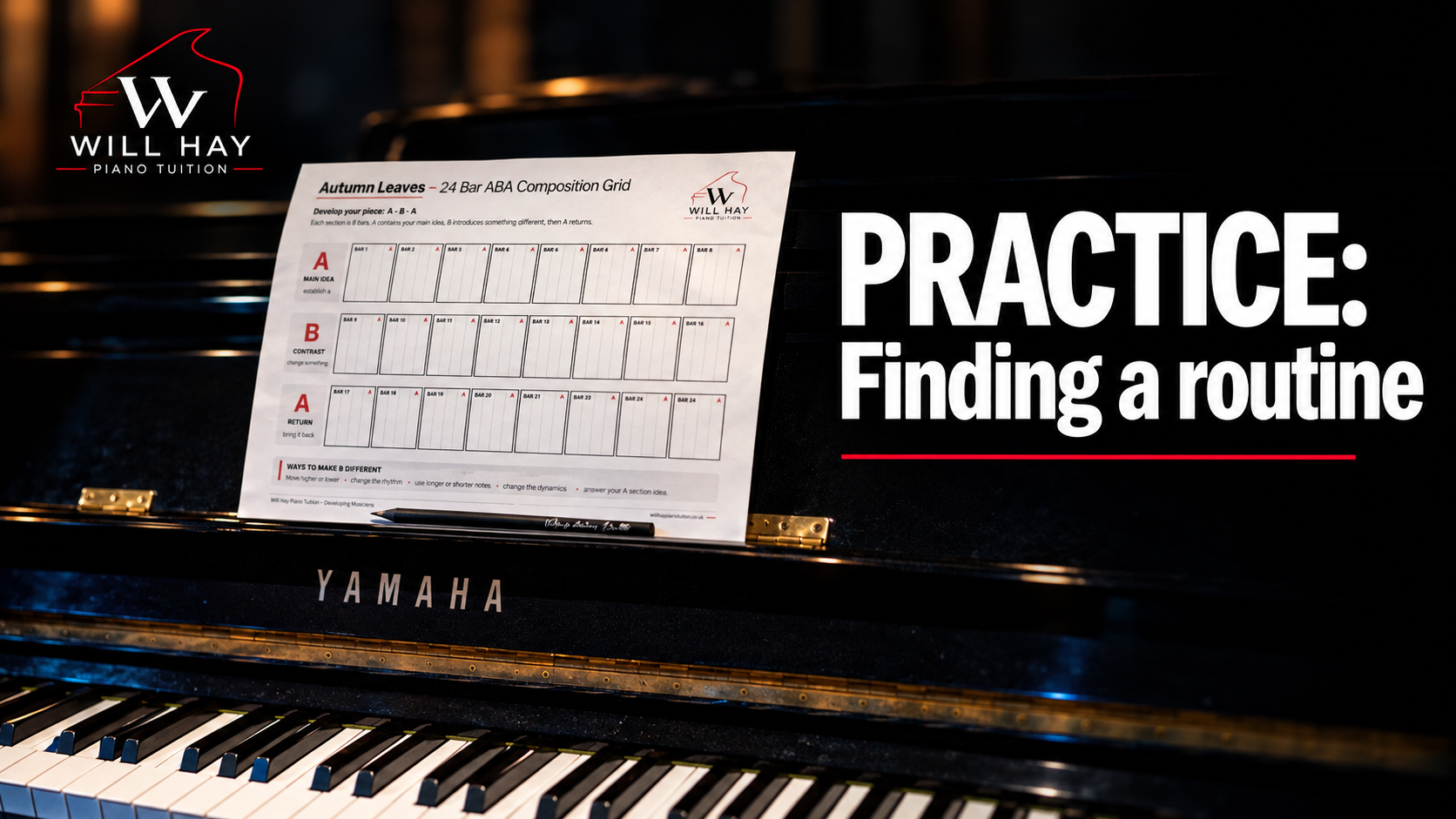
    Our Autumn Leaves project has included improvising, composing, experimenting with dynamics and musical games. All of those can be part of practice too.

    I’ve recently shared a reel with Ted demonstrating our two-bar call and response activity. It’s something parents can easily try at home, even if they don’t play the piano.

    Ask your child to play you a short musical call. Try answering it. Then swap roles.

    It doesn’t need to be clever. You’re simply listening, experimenting and making music together.

    So a short practice session might include a piece, a tricky passage, some Autumn Leaves call and response, and a few minutes playing something simply because you enjoy it.

    Perhaps my original three questions need a fourth:

    Where? When? Reward? Routine?

    Because the more answers I hear, the more I think routine might be the most important one of all.

  • What are we practising?

    What are we practising?

    I’ve already had a few students arrive at lessons this term and tell me, very honestly:

    “I haven’t practised this week.”

    For me, this is probably one of the biggest challenges in teaching the piano. I can demonstrate, explain, encourage, choose music, create projects and set goals, but ultimately progress happens in the time between lessons.

    A conversation with one of my students this morning rather neatly summed up the question of who is responsible for that practice.

    He told me:

    “My mum hasn’t practised with me this week.”

    I asked him whether his mum was having piano lessons.

    Apparently not.

    What he meant, of course, was that she hadn’t helped him to practise.

    So I asked another question: is it Mum’s job to make sure you practise?

    And perhaps an even better question: if you need Mum’s help, whose responsibility is it to ask for that help?

    Whose responsibility is practice?

    For younger students especially, I think the answer is that it’s a shared responsibility.

    Parents can provide the structure: reminding children, helping them find a regular time, listening, encouraging and occasionally helping them work out what the strange scribble in their notebook means.

    But as students get older, I want them gradually to take more ownership themselves.

    That might mean remembering what we worked on in the lesson, choosing when they are going to practise, getting their music out without being asked, or going to find a parent when they genuinely need some help.

    Learning to practise is, in itself, something we have to learn.

    Play. Progress. Enjoy.

    The three words underneath my piano tuition logo are:

    Play. Progress. Enjoy.

    They’re deliberately in that order.

    If you don’t play, it becomes very difficult to progress.

    And if you constantly feel as though you’re starting again at every lesson, it becomes much harder to enjoy playing too.

    Practice doesn’t always need to mean a long, serious session at the piano. In fact, particularly for younger students, little and often can be far more useful than one heroic burst immediately before the lesson.

    Five or ten focused minutes on several days of the week can achieve a surprising amount.

    Sometimes it might mean working carefully on two bars.

    Sometimes it might mean playing through a favourite piece.

    Sometimes it might mean improvising, playing a duet part, experimenting with the Autumn Leaves project, or simply sitting at the piano and playing.

    The important thing is consistency.

    So what are we practising this week?

    Over the next few lessons I’m going to be talking to students about how they practise, not simply whether they have practised.

    What helps them remember?

    When is the best time?

    Do they prefer practising before school, after school or after dinner?

    Do they know exactly what they are supposed to work on when they sit down?

    And, perhaps most importantly, what can they take responsibility for themselves?

    Parents absolutely have a part to play, particularly with younger children. But ultimately I want students to develop the habit of thinking:

    “This is my music. This is what I’m working towards. What am I going to do this week to get there?”

    So this week, the challenge is very simple:

    Spend some time playing the piano, consistently, throughout the week.

    Because everything else starts there.