-
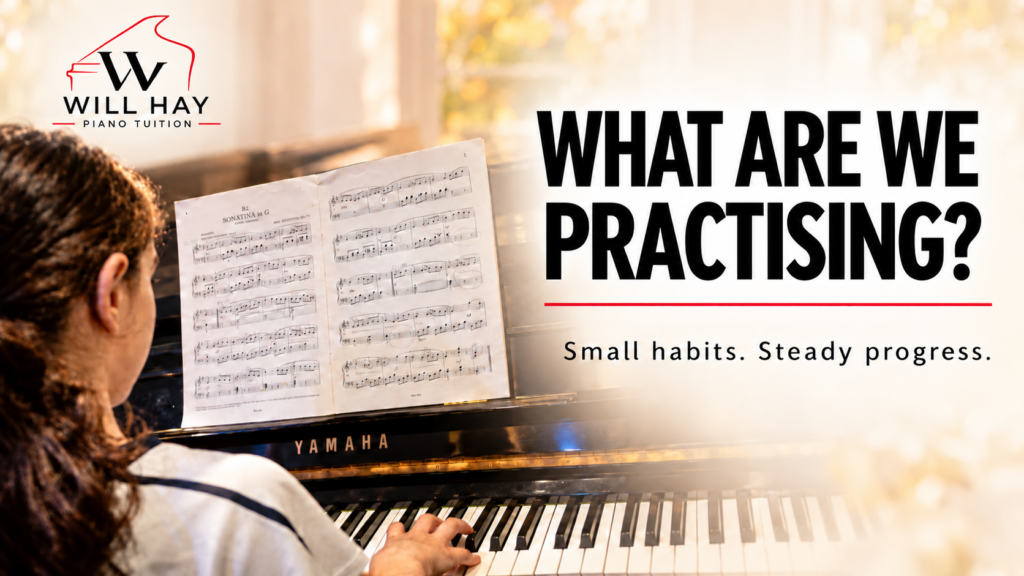
What are we practising?
I’ve already had a few students arrive at lessons this term and tell me, very honestly:
“I haven’t practised this week.”
For me, this is probably one of the biggest challenges in teaching the piano. I can demonstrate, explain, encourage, choose music, create projects and set goals, but ultimately progress happens in the time between lessons.
A conversation with one of my students this morning rather neatly summed up the question of who is responsible for that practice.
He told me:
“My mum hasn’t practised with me this week.”
I asked him whether his mum was having piano lessons.
Apparently not.
What he meant, of course, was that she hadn’t helped him to practise.
So I asked another question: is it Mum’s job to make sure you practise?
And perhaps an even better question: if you need Mum’s help, whose responsibility is it to ask for that help?
Whose responsibility is practice?
For younger students especially, I think the answer is that it’s a shared responsibility.
Parents can provide the structure: reminding children, helping them find a regular time, listening, encouraging and occasionally helping them work out what the strange scribble in their notebook means.
But as students get older, I want them gradually to take more ownership themselves.
That might mean remembering what we worked on in the lesson, choosing when they are going to practise, getting their music out without being asked, or going to find a parent when they genuinely need some help.
Learning to practise is, in itself, something we have to learn.
Play. Progress. Enjoy.
The three words underneath my piano tuition logo are:
Play. Progress. Enjoy.
They’re deliberately in that order.
If you don’t play, it becomes very difficult to progress.
And if you constantly feel as though you’re starting again at every lesson, it becomes much harder to enjoy playing too.
Practice doesn’t always need to mean a long, serious session at the piano. In fact, particularly for younger students, little and often can be far more useful than one heroic burst immediately before the lesson.
Five or ten focused minutes on several days of the week can achieve a surprising amount.
Sometimes it might mean working carefully on two bars.
Sometimes it might mean playing through a favourite piece.
Sometimes it might mean improvising, playing a duet part, experimenting with the Autumn Leaves project, or simply sitting at the piano and playing.
The important thing is consistency.
So what are we practising this week?
Over the next few lessons I’m going to be talking to students about how they practise, not simply whether they have practised.
What helps them remember?
When is the best time?
Do they prefer practising before school, after school or after dinner?
Do they know exactly what they are supposed to work on when they sit down?
And, perhaps most importantly, what can they take responsibility for themselves?
Parents absolutely have a part to play, particularly with younger children. But ultimately I want students to develop the habit of thinking:
“This is my music. This is what I’m working towards. What am I going to do this week to get there?”
So this week, the challenge is very simple:
Spend some time playing the piano, consistently, throughout the week.
Because everything else starts there.
-
What would you like to achieve on the piano by Christmas?
Last week, I asked all my students a simple question:
“What would you like to achieve on the piano by Christmas?”
“Guitar” was perhaps the most amusing answer, although I’m not entirely sure that particular student had understood the question!
While some students weren’t quite sure yet, others had plenty of ideas. Common suggestions included learning a favourite piece or progressing to something more challenging. One student wanted to “play a duet with another student”, while another wanted to “make up my own songs.”
Thankfully, both composition and ensemble playing are already part of my piano curriculum, so those answers have given me some ideas for the term ahead.
Where appropriate, I’ll be pairing students up by overlapping lessons during the course of the term, giving them the opportunity to experience playing together. Hopefully, we’ll be able to share some of those duets at our forthcoming concerts in November.
Making up our own music
Another strand I’m introducing this week is composition. Throughout the term, I’ll be encouraging students to take part in my Autumn Leaves Project, using improvisation as a simple and accessible introduction to creating their own music.
The idea is to take away some of the mystery of composition. Rather than beginning with notation and lots of rules, students will start by experimenting at the piano, making musical choices and discovering what sounds good to them.
As the project develops, I’m hoping to showcase some of their creations at the November concerts too.
So, between favourite pieces, duets, compositions and increasingly ambitious repertoire, there should be plenty for us to work towards this term.
And as for the guitar? That one might be outside the piano curriculum.
-
Fresh Starts in the Studio
Welcome to the new academic year—and to the first edition of Studio News!
September always feels like a time for fresh starts. Returning pupils are beginning new pieces and setting themselves new challenges, while several new pupils are taking their first steps at the piano.
The studio has had a fresh start too. I’ve given it a thorough tidy and reorganised the space so that it feels brighter, calmer and more welcoming. It’s surprising what a difference a little more space and a better flow can make. It’s reassuring that many of my students nave noticed the difference too!
New music for a new term
One of the nicest things about the beginning of term is choosing what to play next. Around the studio, pupils are starting all sorts of new music—from first tunes and teacher duets to classical pieces, film themes, pop songs and exam repertoire.
Although developing technique and musical skills is important, I also want pupils to play music that genuinely interests them. If there is a particular piece, song or style of music you would like to explore this term, please tell me during your lesson. I’m always happy to investigate suitable arrangements and suggestions.
What would you like to achieve?
This week, I’ll be asking pupils a simple question:
If you could achieve one thing at the piano by Christmas, what would it be?
Your answer might be:
- learning a particular piece;
- playing with greater confidence;
- improving sight-reading or rhythm;
- establishing a better practice routine;
- preparing for an exam;
- performing in front of an audience;
- or simply enjoying playing the piano more often.
There is no single right answer, and a goal doesn’t need to be enormous to be worthwhile. I’ll bring some of the studio’s suggestions together—anonymously—in next week’s Studio News.
Autumn Piano Concert
We already have something exciting to work towards: our Autumn Piano Concert on Sunday 15 November at 2pm at The Firs School.
The theme will be Share Something You Enjoy. This will be an informal, supportive open-mic-style concert, so pupils can perform music at any level. Pieces don’t have to be extremely difficult—or completely perfect—to be worth sharing. Duets and shorter pieces will be very welcome too.
Afterwards, we’ll stay for coffee, soft drinks and cakes to share, making it a relaxed social occasion for pupils and their families.
Nobody needs to decide immediately, but now is a good time to begin thinking about a piece you might enjoy playing. Even pupils who are only just beginning may be able to take part, perhaps by performing a simple duet with me.
I’m looking forward to hearing everyone’s ideas and seeing where our music takes us this term!